Friday, July 12, 2013

Minds On Math: Chapter 4 "Community"


It has taken me a while to even begin this post for a few reasons.  Chapter 4 is about the importance of developing a certain culture in your classroom.   It is the culture that I have always envisioned as how my classroom would work.  However, it has not always turned out that way.  The picture above is from one of those days last year where I left school on top of the world.  My students were 100% engaged, my room was filled with a community of learners that were focused on solving a math problem. The time flew by, excellent math discussion took place -BETWEEN STUDENTS, etc.   So why couldn't I have that more often?  Why couldn't that be everyday?  
After reading the first 3 chapters I can tell you one thing about this day...they had a really good task, it was on that half sheet of paper and their group was to find the cost of taking a trip from NY to LA.  That was all the info I gave them, they had to think of and account for everything they would have to pay for in order to take that trip. 
OK, so back to chapter 4.  Hoffer explains that there are three key elements to building a community of learners.
  1. Intention-having a vision and expectations for your classroom
  2. Interdependence-Basically teaching kids how to work together, creating tasks that require group work, not just tasks that could be done solo and throw them into groups just to make groups.
  3. Homeostasis-this section talks about classroom management stuff, hold everyone accountable, give authentic consequences, immediate feedback, self monitoring, etc.  
There are some really great suggestions in each of these three sections. 

One of my biggest takeaways is the idea of presenting my expectations in the form of norms (pg. 53) I loved her chart, and I'm thinking that if I present this to students I can have them create the "rules" of class together, something I've never done.  Actually by posting the Norms of the class, somewhat eliminate a need for a list of rules, the rules become -you're either supporting the norms or your not.  Actually the more I look over her chart the more I love it!  

I have to say I am so glad that I am reading this book now, over summer break, it is really giving me direction and focus for my plans for the coming school year!

Tuesday, July 9, 2013

Minds on Math: Chapter 3 "Tasks"

Chapter 3 continues to describe the reasoning behind the math workshop and the types of activities that are best suited for the "work time".

The Problem of the Day asks: How can we design math learning activities that generate student understanding?

This is where our focus should always be, but it is so easy to fall into the idea that you need to first have kids work on the what I like to call "Plain Janes" - just the basic operations or procedures.
Hoffer hits the nail on the head when she talks about the juicy problems being at the end of the chapter and we run out of time to get to them (p.39) That has happened to me more times than I can count!  But those "juicy problems" are where the math all makes sense!  If your students are asking "why do I have to learn this?" all the time, I don't think they CAN take ownership of their learning.

Another thought about the tasks is this is exactly where you can differentiate (please bear with me, I still consider myself a new teacher!) not in the teaching, but in what students are asked to do.  Again, I really like the way Hoffer lays out the way to modify existing tasks (p. 42)  this would work great by having all students work on the "same problem" but just a little bit differently so that when you come back to reflect as a class everyone can understand and participate in the discussion.

Sunday, July 7, 2013

Bloglovin

Follow my blog with Bloglovin

Finally checked out Bloglovin and it looks like a good one to replace Reader.  Not crazy about the name, but that's ok!

Saturday, July 6, 2013

Minds on Math: Chapter 2-Tools

This chapter describes the tools students need to construct understanding.  Constructing understanding is something I have been really thinking about especially this last year.  I find that I can teach math concepts and have students do well on the chapter test, but not have "learned" it.  I have always told my students that this is not just math class, it is thinking class: you have to learn how to think!
So this chapter continues to have me nodding my head in agreement.  However, it is a little overwhelming!  There are three sets of "tools" outlined in this chapter:

  • The Common Core Standards of Mathematical Practice
  • Twenty-First-Century Skills
  • Thinking Strategies

We are using Singapore Math-Math in Focus starting this year and one of features I really liked about it was it lines up the CCS Mathematical Practices with each lesson!  So that part will be extremely easy for me to integrate into my lessons and the charts Hoffer give on p.22 and 23 are going to be invaluable when I am planning! I can already tell that this book is going to be well worn by the end of the year!

Twenty First Century skills seem to be what the "workshop" idea is all about.  This is where my students are going to need the most guidance.  They are so used to being told explicitly what to do when it comes to math that it is hard for them to get creative.  They just want to be told how to do it and get frustrated and shut down.  This year I plan on spending a good bit of time in the beginning just teaching these skills.

Finally the Thinking Strategies...I love these!  I am also reading Comprehending Math by Arthur Hyde and he uses these strategies as well.  I was introduced to his KWC strategy at the end of the year by my math coach and it worked so well when I could get the kids to use it.  This year I will be teaching it at the beginning of the year so hopefully I won't have to beg them to use it!  KWC for problem solving is similar to KWL charts in ELA, K is what do you know about the problem, W is what is the question, or what are you trying to find out, and C is what are the conditions or restraints.


Wednesday, July 3, 2013

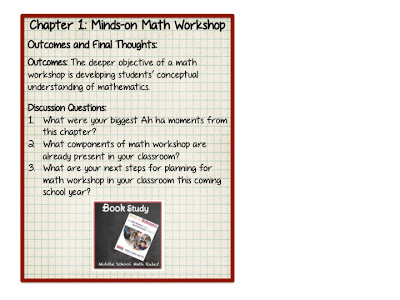
Minds on Math Book Study - Chapter 1 Minds On Math Workshop

I decided to join in with Sherrie Nackel's book study- Minds on Mathematics: Using Math Workshop to Develop Deep Understanding in Grades 4-8 by Wendy Ward Hoffer and I am so glad I did!  It was a last minute decision and I finally received my book last night.   So I'm hopping in a little late, and with company visiting this week I will be behind, but it looks like it will be well worth it!

For the first chapter Sherrie gave some discussion questions so I will start here.

From Sherrie's blog http://7thgrademathteacherextraordinaire.blogspot.com/
The biggest Ah ha moments from the first chapter for me:
The chapter highlights the theory behind the minds on math workshop and it was a little like preaching to the choir.  I completely agree that kids are not learning by being talked at.  Although I try so hard not to do it, I am 100% guilty of "putting on the show" or doing the math "tricks" on the board. Although I have gotten much better at it, I am also guilty of jumping in to save them when they are stuck.  I have always subconsciously  thought to myself that if I just "show them how easy it is" they wouldn't be so frustrated.   I am learning that the "struggle" is good!  That is when the learning happens.  If they are not struggling, they already knew it and they are not learning anything! One of things I keep searching for is a way to get kids to take ownership of their learning and I think this is the purpose of the workshop.
Another thing that jumps out at me is that this is going to take WORK on my part!  It sounds like such an easy process to implement and extremely worth it, but whew!  I feel like my kids come to me trained not to have to think but to sit, listen and then finish the worksheet.  Plus retraining myself to let go and let them work!

What components are already present in my classroom:
Well, I would say that I have done workshop type stuff already.  The thing is I have not taken the time to make it work.  I have put them in groups, given them jobs, given open ended problems for them to work on, etc.  I do know that while it didn't always work out the way I wanted, most of the times these types of lessons were the ones I thought were really good.  

What are the next steps for planning workshops in my classroom:
I have to say that I am so happy that I found this book over the summer!  I think the first step is going to be to read through the whole book :)  I know that I will have to rework all of my classroom routines and procedures but like I said I have a feeling that this is going to be well worth it!  


I am excited to read the rest of this book.  Along with a new curriculum next year I have my work cut out for me.  Fortunately, this is the kind of stuff I thrive on. I love change and challenges! 


Friday, June 28, 2013

Appreciating Summer Break

My husband says I'm a weirdo.  He tells me I am one of those people who can't relax.  Well, he is right.  I don't know how to shut down.  I have to constantly be reading, planning, doing something or I go crazy!
I can read for pleasure, but when I do, I usually devour the book like a box of cookies, and start looking for more (I blew through most of my summer pay last year on amazon.com-darn one click ordering Kindle app!) and I love listening to music, but most of the time I end up singing at the top of my lungs extremely off key, so my kids usually discourage that!
So I've decided to start appreciating all of the free time I have and not worrying about the fact that I'm not "relaxing" or using it the "right" way according to my hubby, who thinks I should be sleeping until noon and then sipping margaritas for whole month of July and August.

Here are some things I am thankful for right now:
1. Sleeping until 7 a.m. -  I usually get up at 4:30 a.m.
2. Being able to lift weights at around 9-10 a.m.  This is the time my body works best for this activity.
3. Being able to take some cool PD classes without having to worry about planning lessons/grading papers.
4. Having the time to read some good math books and participate in an online book study.
5. Even thought it's the 5th thing on the list it is probably the one I appreciate the most...spending time with my kiddos!  So far this week we've been to our community theater's production of Les Miserables, took a trip to New Hope, PA and today will be going to see my niece and nephew in their summer camp play.
6. Teaching a student for 6 weeks who needs an extended school year. I am not great with saving money, so this will definitely help me relax and not feel so stressed out about running out of cash.  It's only 2.5 hours a day so its not going to eat up a ton of time.

First week down, nine more to go!

Saturday, June 15, 2013

Year End Review

I can't believe the year is almost over!  My 8th graders graduated yesterday and it was bittersweet.  I am really proud of them.  This class has grown up before my eyes.  I am excited for them and their future and at the same time I am so sad to see them go.

Now the point of this blog was to reflect on my teaching and to grow as an educator and I need to get back to that.  My blog began turning into a rant zone, which I thought would be helpful to get out, but since I really hate negativity I ended up avoiding my own blog!!  So to get back on the right track here is a small review of this year, the things I liked, didn't like and goals for next year.

Flipping
This year I started out with recording screen casts of just my vocab and basic examples.   I was pretty happy with the way it  was working at first, most of the kids were able to watch the videos and they all kept up with their notes.  I began to notice that some students were just copying from other kids notes and not watching the videos.  At first I didn't mind since they were still doing the "work" of copying the notes, but I knew that I wanted to take these videos further then just basic screen casts and this started to irritate me because I knew that these kids would have problems down the road.  How could this be changed?   I didn't do a good job of teaching them how to learn from the videos and that is what caused that problem.
As we got closer to April (state testing time) I started to get really anxious about test scores and I didn't feel like my students were making progress so I stopped making my videos and went back to traditional lectures.  Again, I feel that it was my fault for not managing class time as effectively as I could.  So I don't think the videos were the problem with them not succeeding.
This year I am taking a free online course https://sites.google.com/site/flippedclassroomprogram/home and so far I love it! In addition to making more engaging videos that include me (YIKES) I am already learning some great things to do with them in class to differentiate.  I am hoping to film most of my videos over the summer. It is a HUGE task, but I think in order for next year to be successful, it must be done this way.  I am hoping to be able to go into my building to do so since the lighting is much better, but my plan B is to film them out in my garage.  I've done 5 already and they pretty much suck!  I have got to learn to jazz them up since I am so used to interacting with my students during my lessons and I use a lot of questioning instead of telling during my lessons.

Edmodo
I still LOVE Edmodo.  We kind of got away from it when I stopped making videos, but the kids really loved it too. It seemed easier to share things with them on Edmodo than our school's SIS/LMS. Next year I want the students to use it more for interacting with the content instead of socially.
 
iPads
So my school has two COWS and I never ever use them because there is always issues such as power, connectivity, etc.  We recently got iPads and they seemed to work much better!  Since I don't have an iPad personally it was kind of hard for me to plan things because I don't know what works and what doesn't on them.  The one thing we did try out was the app Socrative.   It was really cool, but we just basically "played" with it like a toy.  It has such potential in my room that I will have to really plan out productive uses for it this summer.

Circle Trackers 
We started using these to track student's mastery of concepts taught this year.  It is basically a spreadsheet with the students names and columns labeled with the concepts taught.  As you observe the students you draw a circle for each concept and then start shading it in as they progress, so when a student fully masters the concept their circle is completely shaded.  It sounds simple enough, but it really was difficult to implement.  I like to carry around a composition notebook during class and record notes and things and it seemed like too much to also have to carry that with it and find the kids name and fill it in (it sounds silly when I write this but it is what it is!)  Now something that I am really interested in and think might work better for me is a program called Mastery Connect.  It is a website that automatically tracks students mastery by scanned bubble sheets.  I could see myself having students complete  3-5 questions and having them scan their own sheets to collect the data.  We played around with a similar program this year called Gradecam and it was pretty effective.

Six actual school days to go, now that I have sent off my 8th graders I am actually feeling energized about next year.  I know that I will post more in the summer and my goal is to really make this a productive one!