Showing posts with label Minds on Mathematics. Show all posts

Saturday, March 8, 2014

Starting to "Click"

I have been so excited about the way a few small changes can totally transform the way my classroom works.  I love reading and learning about new methods and ways of becoming a more effective teacher.  Over the summer I read Minds on Mathematics: Using Math Workshop to Develop Deep Understanding in Grades 4-8 by Wendy Ward Hoffer, and I was hooked.  It sounded amazing and exactly how I wanted my classroom to run.  
After going through the PD of our new curriculum, I didn't know how it was going to work out.  One of my biggest flaws especially with teaching is if I don't think I am doing something perfectly, I feel like I'm wasting precious time with my students who for the most part struggle with math.  So I have been floundering with the workshop model because I thought I should stick with my usual way until I learn the new curriculum. 
So the way I've always taught is the "I do, we do, you do" model.  Even when I incorporated some flipping, my videos were still the "I do's" and then we did the other two parts in class.  I've never given enough struggle time and I think that is the missing link, no matter what method you use to give it.
With that as my goal, the first thing I did was cut my "I do"  or mini lesson way down.  I began to only model a very basic example of the main concept, point out important vocabulary, or model my thinking process-not necessarily a step by step of how to solve each problem.  

Next I set them out to read and discuss the worked out examples in the textbook.  The most important thing I've done here is I give them guided questions that they need to answer while they are reading the examples and they are to use them for their discussion.  The greatest thing is that I can see after two weeks, some of the kids are starting to ask their own great questions that I didn't write out!  See in the past if I asked them to do any type of pair/share or discussion, they would spend about a minute saying "what did you get? I got this" and think that was all they had to do.  The questions are the key!   On a side note, my students have no clue how to read a math book and use it as a tool.  I can't tell you how many times they won't turn in their homework because they say they don't know how to do it and I ask them "well why didn't you look at the example in your textbook?" and they look at me like I have 3 heads.  I'm hoping they will also start learning how to use this tool to help them. 

Next I have them work together on 3-5 practice problems this is where they start to struggle and I walk around and check to see if they are working through their struggle. Once they are successful with these problems I release them to independent work.  When everyone has finished the 3-5 practice problems I stop them and we share out. I purposely let some of the errors be shared so we can discuss it and the kids are already getting used to that!  

I know I am way more excited about this than its probably worth, but that's because I can't really articulate the way the culture has changed in room from just these really small changes.  But I am liking what I see and even though we haven't tested on the new chapter yet, the way the kids are talking about the content is definitely different than they was they did before.
I know that things take time, but I can really see how I am going to keep working towards the workshop model and feel like even though its not perfect right now, its going to keep getting better and better.

Sunday, August 18, 2013

2013-2014 Goals

I am linking up again finally with Julie at I Speak Math for a Sunday Funday!!


I am having a hard time wrapping my head around the fact that summer is almost over!  Last year I felt so much more prepared with my goals for the upcoming year.  The only thing I wanted to do was to get my NJAsk scores higher.  While they didn't reach the goal I hoped, both the 7th and 8th grade scores did go up by 58%! I'm pretty happy with that!

This year is scary, my principal left, along with 5 other teachers.  I know that so much change in a school can be a bad thing.  I am really hoping that we will get through it and have a good year despite the changes.
In addition to that, we are finally moving fully to common core and got new textbooks: Math in Focus-Singapore Math.  For the past three years I haven't really used a textbook so this should be interesting.

My goals for this year are to incorporate the math workshop model into my lessons. I read this book because  Sherrie at Middle School Math Rules! started a book study blog on it and I was hooked!  I also took (am taking) the How To Learn Math course by Jo Boaler through Stanford University which is wonderful and the two just go together perfectly.  Basically I want to get my kids working on more complex problems and discussing them more.

Over the past two years I've found myself trying to figure out why my kids can't retain what they learned.  The book and the course talk about how when we try to teach kids to memorize procedures they will quickly forget it and we have to get them involved and really owning the math.  This is my goal for this year.
I plan to forget about "the test" and get my kids to learn to think!

My other goal for the year is to blog more often and more mathematically.  Most of the posts I made last year were not very productive and I need to change that!

Tuesday, July 30, 2013

Minds on Math: Chapter 10 "Sharing and Reflection"

Problem of the Day:  How can we ensure that students end class understanding and retaining their learning?

At the end of the math workshop we need to let students share out either as a whole group or in small groups/pairs. The idea is that talking out their thoughts about the work they just did with their peers will help them retain it better.  After sharing, students should reflect on their own learning by writing about it.

I have always tried to schedule time in my lessons for sharing.  However, we would often run out of time.  Something I notice about the workshop model is that the components seem very familiar to the things I feel I do now (Opening=Do now, minilessons, sharing, etc) but with a different importance placed on them.  I used to let us run out of time if the students were working hard on their classwork, I figured that was when they were learning.  But if by making sure they had that time to share and talk it out they would retain it more, then it will be worth it.  I also like the idea of sharing in pairs or smaller groups.  I like the idea of having the kids get up and pair off with a student from another group at the end.

Now for reflection, I'm thinking, "well, if I run out of time for sharing, how in the world am I going to have time for reflection?!"  One of my thoughts is, why not make it part of the opening routine.  This way students can reflect on what they learned the day before in preparation for the day's lesson.

I am now ready to reread this whole book and really get down to planning out my workshops!

Saturday, July 27, 2013

Minds On Math: Chapter 9 "Conferring"

Problem of the Day:  How can you get to know your students individually as math learners, promote their confidence and growth?

This chapter discusses what teachers can do while students are busy during work time-meet with students.  Two things really stick out about this chapter, one is the need to really organize and plan how you will confer with students and the second is teaching students how to confer with you and how to act when you are conferring with others!

Starting off with the plan of attack, according to the author, we should be doing three things:  finding out exactly where the student is in the learning process, guiding the student towards the learning goal and making notes about the progress/meeting (p 145-146)  I absolutely love the list of questions for each stage provided on page 147.  This would be a good thing to laminate and attach to my clipboard as I go around to students.

Next, this process is a routine that will need to be introduced and explained so that students don't feel like they are being put "under the spotlight" and so that other students learn to respect others' time.  Students need to learn what the purpose of the meeting is and how it will help them.  They need to buy into the fact that it will benefit them.  They also need to learn that individual meetings must be respected. This will definitely be one of the procedures I will start the year off teaching.

Hoffer points out that it will take time to learn how to confer with students and at first you might only get to meet with 1 or 2 students per class.  I am wondering if I can confer with groups at a time.  I still haven't decided how I am going to group my students for work time yet, but I am thinking if I have a preset group, I can make record sheets for each group which might make it easier to meet with more students and record/reflect.

I really think meeting with students to discuss their learning is important.  Students need to receive meaningful feedback and feedback other than grades.  In the "How to Learn Math" course I am taking there is a big emphasis on learning from mistakes but most of my students have to learn that mistakes are good, this would be a great time to teach this to them.


Tuesday, July 23, 2013

Mind on Math: Chapter 8 "Work Time"

Question of the Day: How can we facilitate thoughtful and productive work time for math learners?

And here we have what I think has got to be the most difficult and most important part of math workshop! Work time is where we schedule these challenging tasks and differentiate learning.

Grouping has always been an issue for me since I teach small classes.  We seem to have anywhere from 5-6 very low students and then 10-11 on level with only about 1-2 truly above level.  My lows sometimes get pulled out as an intervention with the RTI specialist, so I've tended to put them together in the past.  When I mix them up with the others, they totally let the others do the work, even when I give them a task.
This year we are thinking about taking those very low 8th graders and putting them together in one homeroom (there are 3- 8th grade homerooms with 12 students and they stay together for all of their classes) and this is something I keep going back and forth with.  I have read all of the bad things about ability tracking, but I really think that we will do a good job of NOT lowering expectations for these students, but actually push them to achieve more.   So anyway where I am going with this is that if we do go ahead with it, I will have no problem doing random groups all the time, or groups based on their preassessments.   Now the 7th grade is a different story, there are only 2 homerooms with 18 in each.  Not sure how that is going to work.

I think getting the students to actually WORK during this time is going to take a lot of practice and going over the expectations.  I am going to begin the year by describing my Norms of the class and having the students create strategies and rules and I am hoping that this will help.  I keep having these delusions that if I just come up with tasks that are challenging and engaging enough, they will just get to it!  But I'm sure it is going to take a lot more work on my part!

Which leads into what the teacher is doing during this time:  I cannot wait to get into the conferring section.  I know from the How to Learn Math course, that giving good feedback is really essential for learning and students thinking about their ability to learn.  There is also gathering data which we are required to do in my school anyway.  We use a circle chart.  It is a spreadsheet with the students names listed in the left column and the concepts we are teaching along the top row.  We leave the box empty if students don't have any understanding, one line of a plus sign if they are beginning to get it and then a full plus if they got it.

I am getting really excited about planning everything for this school year using the workshop model!

Sunday, July 21, 2013

Minds on Math: Chapter 7 "Minilessons"

Problem of the Day: How do you set students up for success as independent thinkers and problem solvers?

This chapter has a lot to offer.  The minilessons are our chance to teach students to think like mathematicians. The purpose or goal is not to teach algorithms or procedures but to model the thinking by doing things such as highlighting the use of background knowledge and teaching problem solving skills.

This is an idea that I will have to get used to since I am a relatively new teacher and have been coached in my approximately 3 years teaching to demonstrate the steps.  My school is big on the "I do","We do", "You do" method.  However I feel like that this method requires students to see every type of problem done in order to learn it.  They are learning to follow steps instead of learning how to think mathematically.  I am hoping that focusing on teaching the mathematical thinking will help them to learn how to apply the concepts, rather than just imitate the steps.

Oh and I have to share some GREAT videos from a school that uses the math workshop.  It really is cool to see it in action!  Check them out here: 6th Grade and 7th Grade

Saturday, July 20, 2013

Minds on Math: Chapter 6 "Opening"

I call this chapter the beginning of "getting down to business" of a math workshop.
The problem of the day is: How do you start math class?

Seems to be pretty obvious that we need to start out our class with some sort of warm-up, bell-work, do now, etc.  This was one of the first things you learn when learning about lesson plans! Hoffer reminds us how important the opening activity of our class is to setting the tone of the day and activating prior knowledge.

I have always used a "do now" in my lesson plans and my class routines. My idea of a Do Now is the task students should do when they come in that does not need any explaining on my part.  They should come in, take out stuff for class and get to work.  My experience is that I usually just throw up a computation problem, probably what we did the day before, and some of the kids race through it or do it in their head and  some kids have no clue what to do and just sit and wait for others to finish it.  Another struggle I have is no matter how much I try to remind and enforce my beginning of class routine, my kids take their time getting in, getting their stuff put away and getting to business.  I wonder if it is because of my "lame" openers?

I am thinking after reading this chapter that one of my goals will be to really work on my openers and beginning of class procedures!

Thursday, July 18, 2013

My Flipped Classroom 2.0

After posting my thoughts on Minds on Mathematics: Chapter 5 "Discourse" ,Sherrie Nackle, who is organizing this really great book study here, commented on how would I implement the workshop model and flipping.
"I am very interested in hearing more about how you will incorporate your flipped teaching into workshop model. I've seen other teachers do flipped learning, but the videos were strictly skill based. How do you get the deep conceptual understanding with a video? I'd love to hear more about this."

So I started to respond, but it turned out to be more of me working out my thoughts of the way I wanted to start planning for next year.  I'm not quite ready to do that yet since I am not finished with the book and am taking another online course (a really great one by the way!  Check it out here.) But I did think it would be better for a blog post in order to organize my thoughts since they were flowing pretty well!

Ok, so back up a bit. Last summer I "discovered" the flip classroom, hence the name of my blog!  I really thought this was going to be the key for my students and my motivation behind it was to encourage more higher order thinking in my classroom by having more time to do so and also I won't lie, I thought it might help with behavior.  I figured the less time they had to sit quiet and listen to me lecture in class, the less time they had to act up.  In some ways it worked well, my videos were mostly just vocabulary notes and a very quick example of what we would be doing for that concept.  It was a way for kids to copy the notes without doing it in class.  They could go at their own pace and didn't have to wait for others to finish etc.  I never really "taught" on the video and they never took ownership of the learning.  I still had to teach in the classroom, they just had less notes to copy!

So, I still thought (think) the flipped model is beneficial, I just needed to work at it more, of course I didn't think I would get it perfect the first year.  I saw that Dr. Lodge McCammon and Katie Gimbar were offering their online "Flipped Classroom Training Program" so I applied and got accepted into it.  I really like their method of filming one take videos with the teacher in them, opposed to screencasts (which I was doing originally) and I thought that taking the course would help me become better at this. 

During the course, I realized that the way I like to teach is with questioning and feedback from students.  It was very hard to teach to a video camera!   Dan Myer even questioned my motivation for flipping with his comment on my blog:
"I have got to learn to jazz them up since I am so used to interacting with my students during my lessons and I use a lot of questioning instead of telling during my lessons."

But isn't this an argument against flipping the classroom? You're saying you're trading "questions and interactions" with "telling and jazz" and it seems you're feeling troubled by that. So what else do you (or your class) get in that trade that makes the flipped classroom worthwhile?

I have to say that made sense, I agreed with that comment, but something was still holding me on to the flipped classroom.  That is what really made me think about what I need to accomplish in my classroom and how the videos were going to help me achieve those goals. 
Finally, this is what leads me to my thoughts on flipping with workshop:
What i have learned so far with all of my PD this summer is that kids need to get their hands dirty working with those complex open ended problems, they need to construct their own understanding of the math.  However, I know my kids and I know some of them need to first get those basic lower level skills down and have them modeled for them before they start playing with it.  Some don't.  That is why I am thinking that my videos will teach very basic "procedures" of a concept, along with trying approx 5 of those basic problems for homework. You know those very basic computation problems the textbook starts out with.  When they come to class we will work on the workshop model in order for them to construct meaning for why we do those procedures and when to apply them.  I am really looking forward to finishing the book and start digging into my planning!  

Tuesday, July 16, 2013

Minds on Math: Chapter 5 "Discourse"

Problem of the Day:  Why ought and how can teachers facilitate learners engagement in purposeful and meaningful conversations about their thinking?

Great question!  I totally cringed while reading the dialog  piece Hoffer writes about on page 68-69.  I have heard those exact snippets in my room and just couldn't figure out how to stop it!  

Last summer I learned about the "flipped classroom", layered curriculum, and interactive notebooks.  So I recorded a bunch of lessons, created menus of activities and planned out the notebooks.  My vision for my class would be that they watch the video and start their notes for homework, then the first 10 minutes of class would be small group discussion before moving on to the activities.  Things started off okay, but did eventually break down over the course of the year and after reading this chapter I feel that it was because I never taught them how to have those discussions.  I fell into the trap of "if you put them in a group and tell them to talk about math...they will!"  Nooooooo preteens-teenagers do not work that way!

Again, this is another chapter I am going to wear the crap out of while lesson planning!  Not only does Hoffer give detailed outlines for scaffolding and structures (p.80), she also explains how to keep students accountable and how to observe them in their discussions!

Friday, July 12, 2013

Minds On Math: Chapter 4 "Community"


It has taken me a while to even begin this post for a few reasons.  Chapter 4 is about the importance of developing a certain culture in your classroom.   It is the culture that I have always envisioned as how my classroom would work.  However, it has not always turned out that way.  The picture above is from one of those days last year where I left school on top of the world.  My students were 100% engaged, my room was filled with a community of learners that were focused on solving a math problem. The time flew by, excellent math discussion took place -BETWEEN STUDENTS, etc.   So why couldn't I have that more often?  Why couldn't that be everyday?  
After reading the first 3 chapters I can tell you one thing about this day...they had a really good task, it was on that half sheet of paper and their group was to find the cost of taking a trip from NY to LA.  That was all the info I gave them, they had to think of and account for everything they would have to pay for in order to take that trip. 
OK, so back to chapter 4.  Hoffer explains that there are three key elements to building a community of learners.
  1. Intention-having a vision and expectations for your classroom
  2. Interdependence-Basically teaching kids how to work together, creating tasks that require group work, not just tasks that could be done solo and throw them into groups just to make groups.
  3. Homeostasis-this section talks about classroom management stuff, hold everyone accountable, give authentic consequences, immediate feedback, self monitoring, etc.  
There are some really great suggestions in each of these three sections. 

One of my biggest takeaways is the idea of presenting my expectations in the form of norms (pg. 53) I loved her chart, and I'm thinking that if I present this to students I can have them create the "rules" of class together, something I've never done.  Actually by posting the Norms of the class, somewhat eliminate a need for a list of rules, the rules become -you're either supporting the norms or your not.  Actually the more I look over her chart the more I love it!  

I have to say I am so glad that I am reading this book now, over summer break, it is really giving me direction and focus for my plans for the coming school year!

Tuesday, July 9, 2013

Minds on Math: Chapter 3 "Tasks"

Chapter 3 continues to describe the reasoning behind the math workshop and the types of activities that are best suited for the "work time".

The Problem of the Day asks: How can we design math learning activities that generate student understanding?

This is where our focus should always be, but it is so easy to fall into the idea that you need to first have kids work on the what I like to call "Plain Janes" - just the basic operations or procedures.
Hoffer hits the nail on the head when she talks about the juicy problems being at the end of the chapter and we run out of time to get to them (p.39) That has happened to me more times than I can count!  But those "juicy problems" are where the math all makes sense!  If your students are asking "why do I have to learn this?" all the time, I don't think they CAN take ownership of their learning.

Another thought about the tasks is this is exactly where you can differentiate (please bear with me, I still consider myself a new teacher!) not in the teaching, but in what students are asked to do.  Again, I really like the way Hoffer lays out the way to modify existing tasks (p. 42)  this would work great by having all students work on the "same problem" but just a little bit differently so that when you come back to reflect as a class everyone can understand and participate in the discussion.

Saturday, July 6, 2013

Minds on Math: Chapter 2-Tools

This chapter describes the tools students need to construct understanding.  Constructing understanding is something I have been really thinking about especially this last year.  I find that I can teach math concepts and have students do well on the chapter test, but not have "learned" it.  I have always told my students that this is not just math class, it is thinking class: you have to learn how to think!
So this chapter continues to have me nodding my head in agreement.  However, it is a little overwhelming!  There are three sets of "tools" outlined in this chapter:

  • The Common Core Standards of Mathematical Practice
  • Twenty-First-Century Skills
  • Thinking Strategies

We are using Singapore Math-Math in Focus starting this year and one of features I really liked about it was it lines up the CCS Mathematical Practices with each lesson!  So that part will be extremely easy for me to integrate into my lessons and the charts Hoffer give on p.22 and 23 are going to be invaluable when I am planning! I can already tell that this book is going to be well worn by the end of the year!

Twenty First Century skills seem to be what the "workshop" idea is all about.  This is where my students are going to need the most guidance.  They are so used to being told explicitly what to do when it comes to math that it is hard for them to get creative.  They just want to be told how to do it and get frustrated and shut down.  This year I plan on spending a good bit of time in the beginning just teaching these skills.

Finally the Thinking Strategies...I love these!  I am also reading Comprehending Math by Arthur Hyde and he uses these strategies as well.  I was introduced to his KWC strategy at the end of the year by my math coach and it worked so well when I could get the kids to use it.  This year I will be teaching it at the beginning of the year so hopefully I won't have to beg them to use it!  KWC for problem solving is similar to KWL charts in ELA, K is what do you know about the problem, W is what is the question, or what are you trying to find out, and C is what are the conditions or restraints.


Wednesday, July 3, 2013

Minds on Math Book Study - Chapter 1 Minds On Math Workshop

I decided to join in with Sherrie Nackel's book study- Minds on Mathematics: Using Math Workshop to Develop Deep Understanding in Grades 4-8 by Wendy Ward Hoffer and I am so glad I did!  It was a last minute decision and I finally received my book last night.   So I'm hopping in a little late, and with company visiting this week I will be behind, but it looks like it will be well worth it!

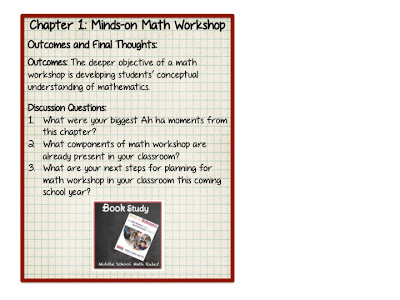
For the first chapter Sherrie gave some discussion questions so I will start here.

From Sherrie's blog http://7thgrademathteacherextraordinaire.blogspot.com/
The biggest Ah ha moments from the first chapter for me:
The chapter highlights the theory behind the minds on math workshop and it was a little like preaching to the choir.  I completely agree that kids are not learning by being talked at.  Although I try so hard not to do it, I am 100% guilty of "putting on the show" or doing the math "tricks" on the board. Although I have gotten much better at it, I am also guilty of jumping in to save them when they are stuck.  I have always subconsciously  thought to myself that if I just "show them how easy it is" they wouldn't be so frustrated.   I am learning that the "struggle" is good!  That is when the learning happens.  If they are not struggling, they already knew it and they are not learning anything! One of things I keep searching for is a way to get kids to take ownership of their learning and I think this is the purpose of the workshop.
Another thing that jumps out at me is that this is going to take WORK on my part!  It sounds like such an easy process to implement and extremely worth it, but whew!  I feel like my kids come to me trained not to have to think but to sit, listen and then finish the worksheet.  Plus retraining myself to let go and let them work!

What components are already present in my classroom:
Well, I would say that I have done workshop type stuff already.  The thing is I have not taken the time to make it work.  I have put them in groups, given them jobs, given open ended problems for them to work on, etc.  I do know that while it didn't always work out the way I wanted, most of the times these types of lessons were the ones I thought were really good.  

What are the next steps for planning workshops in my classroom:
I have to say that I am so happy that I found this book over the summer!  I think the first step is going to be to read through the whole book :)  I know that I will have to rework all of my classroom routines and procedures but like I said I have a feeling that this is going to be well worth it!  


I am excited to read the rest of this book.  Along with a new curriculum next year I have my work cut out for me.  Fortunately, this is the kind of stuff I thrive on. I love change and challenges!