Sunday, August 18, 2013

2013-2014 Goals

I am linking up again finally with Julie at I Speak Math for a Sunday Funday!!


I am having a hard time wrapping my head around the fact that summer is almost over!  Last year I felt so much more prepared with my goals for the upcoming year.  The only thing I wanted to do was to get my NJAsk scores higher.  While they didn't reach the goal I hoped, both the 7th and 8th grade scores did go up by 58%! I'm pretty happy with that!

This year is scary, my principal left, along with 5 other teachers.  I know that so much change in a school can be a bad thing.  I am really hoping that we will get through it and have a good year despite the changes.
In addition to that, we are finally moving fully to common core and got new textbooks: Math in Focus-Singapore Math.  For the past three years I haven't really used a textbook so this should be interesting.

My goals for this year are to incorporate the math workshop model into my lessons. I read this book because  Sherrie at Middle School Math Rules! started a book study blog on it and I was hooked!  I also took (am taking) the How To Learn Math course by Jo Boaler through Stanford University which is wonderful and the two just go together perfectly.  Basically I want to get my kids working on more complex problems and discussing them more.

Over the past two years I've found myself trying to figure out why my kids can't retain what they learned.  The book and the course talk about how when we try to teach kids to memorize procedures they will quickly forget it and we have to get them involved and really owning the math.  This is my goal for this year.
I plan to forget about "the test" and get my kids to learn to think!

My other goal for the year is to blog more often and more mathematically.  Most of the posts I made last year were not very productive and I need to change that!

Saturday, August 10, 2013

Reflection Based Planning

There are two full weeks left before I head back to school and its time to start planning.  Right now my head is swimming from all of the things I have learned this summer and I'm not sure where exactly to begin, actually I know bits and pieces but need to put it all together.  I figure that the best thing to do is look at where I've been and where I want to go.

Last summer I discovered flipping and interactive notebooks and implemented them with limited success.

My goal for flipping was to provide a resource for struggling learners to be able to go back and watch the lesson again when needed and to be able to take me home with them since most kids say they "get it in class, but forget when they are alone." I also wanted to stop spending so much time on low level work in class and have students discuss and do more higher order thinking.  What ended up happening is while students copied the notes successfully and did like going back to them, I never properly taught them how to work together in groups and to take responsibility for their learning.  So in the end, I kind of went back to a traditional class.  Moving forward:  I am still going to provide basic skill videos and have them complete the low level problems for homework assignments.  I took a Flipped Classroom online training course over the summer that I really liked, the idea is that you should make one take videos with you in them in order to build relationships.  I made about 20 or so that were "eh" now that I have my vision of paring them down to the basic skills I am going to scrap them and redo them in my classroom.  The majority of the ones I did were out in my garage and the lighting was not so great.  I plan on basically modeling the example problems from the textbook.  This way, if someone can't watch the video, they could actually read the book.  Also, this year I will be using a textbook, last year I did not have one.
As far as teaching them how to work together and take responsibility for their learning...well I am implementing this year the math workshop model and that is going to take a whole lot of teaching!  I will probably make a post about how I am going to this in detail.

My goal with the interactive notebooks was to get students to take better notes, keep their notebook (instead of losing it, having one notebook for multiple subjects, etc) I have to say that only one of my 72 students lost their notebooks last year!   The nice thing too was that she was able to update the new one she got I want to say easily (it was a lot of work to recopy) but at least she was able to do it.  The thing that didn't work for me so well was the foldables.  My students took way too long cutting and gluing and coloring that they didn't focus on the math, we ran out of time, etc.  My desks are horrible to put together so it was awkward having a basket or bucket with the supplies on them so that was a problem as well.

Moving forward:  What really helped them was being taught HOW to keep a notebook.  It wasn't the IMN that was so magical, it was just that I taught them what to do with the notebook. This year I told them to get a 1 inch binder in addition to the composition notebook.  I am still thinking about how I want them to completely use the composition notebook, however, I know that I want them to do a lot of writing/reflecting in it.  The binder will be used for notes (I will do a lot of printed guided note pages) and their work.
Speaking of writing, one of the things I want to accomplish with their journals is having them do a writing assignment-like a mini research paper.  I'm not sure if I will make it once a quarter or only one for the year, but I'm thinking I need to go all in on it using the writing standard from ELA and everything.


That is where I am at for now.  I am going to be using this blog over the next few days to really plan out everything.  I feel like I am so behind compared to last year as to my planning, however, I feel so much more prepared mathematically and as a teacher going into this year thanks to some of the pd I've done this summer!  I am really excited to get started!
Over the next two weeks I need to plan: classroom setup and first week activities!


Saturday, August 3, 2013

Books, Books and More Books!

So we are on a little family vaca in Baltimore this weekend.  My daughter turned 16 and didn't want a party, she wanted to visit Edgar Allen Poe's grave site.

 In addition she found a "free" bookstore that she wanted to visit.  It turned out to be the coolest place!  We dropped off a ton of old books that were collecting dust on our shelves and headed in to the "store".


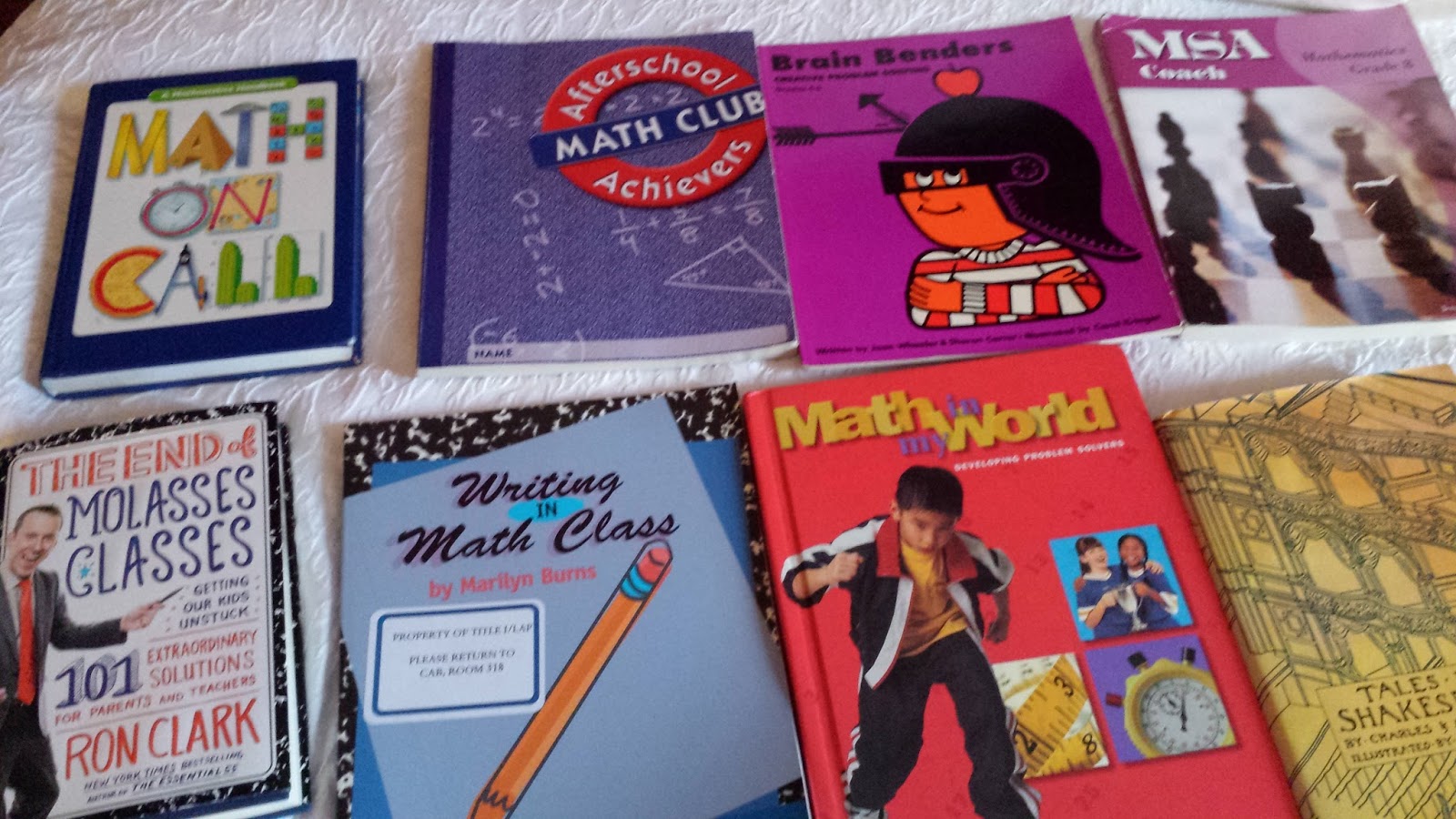
She ended up with about 5 and I found this:

I actually got 4 of those Math on Call books, so that each of my groups can have one for reference :)  Later on we went to the Hardrock cafe and while we waited for our table went over to Barnes and Noble, they were selling the same book for $32 each!!!

I highly recommend The Book Thing if you are in Baltimore, I will definitely like to come back at least once a year or so!

Thursday, August 1, 2013

Mistakes Are Okay, Really!

In the How to Learn Math course, one of the big objectives so far is learning how important it is to let kids know that mistakes are good, they are how we learn and make our brain grow.   One of the things I know is that my students are going to have to be shown this.  I can't just tell them and hope that they magically change the way they have thought about math class for most of their life.  So I've been trying to think of how I'm going to do that and of course it will be my daily actions over time that will make this sink in, however, I wanted some way to really put it out there the first week and I think I might have found it!

Somehow the game Guess Who? popped into my head. Its perfect, because you can use all of your WRONG guesses to eliminate characters in order to guess your opponents character.  I don't have the cash to buy 9 sets of the game but I found character sheets that you can print out here.  The way I am going to have them play is each student will have a plastic communicator with a character sheet in it.  They will draw a card, made with the smaller images taped onto an index card (don't know if I have the patience to glue/tape all 9 sets-might just do a few and pass the cards around!) in order to get their character. If you never heard of the game, you ask your opponent questions in order to figure out the character they have, like "is your character a girl?" if they say no, you cross out all of the girls (if yes, you cross out all of the boys.)  You keep going until you've eliminated enough to guess their character.   Here is a rough set I made up already:
the game board

The cards to select the characters
My plan is to start using the workshop model right away.  Usually my first week is dedicated to setting up routines and procedures, so this will fit right in.  Here is what I have so far:
Opening:  Students will do a maze.  This will set up the discussion about using mistakes to find the right path.
  Minilesson: This is when I will explain the game and the rules for playing. I'm not sure if I will talk more about mistakes here, but I know that I want to keep this short: no more than 10 minutes.
Work Time: I plan on giving them about 20-25 minutes to play the game.
Conferring:  This is when I will try to meet with as many as I can and get them to start feeling comfortable with this process.  Maybe ask things about the strategies they are using, if they would take a chance on guessing without asking for clues, etc.
Sharing/Reflection: The most important thing I want them to think about is this- Can you win the game if every question you asked was answered with "No."? Hopefully they will see that yes, the "wrong" questions can lead you to the right answer!  I still have to work on the questions, I know I have to give them a LOT of structure, especially in the beginning of the year!  After discussing, I am also going to have them write about the activity in their notebooks.


I know I need to think more about structuring the sharing/reflection time, this is where my kids are going to need a lot of practice.
I'm still not sure of my schedule yet, we have 50 and 75 minute classes, and ABCD days, so each class gets a different amount of time each day.  I'm still not sure how to plan for this.  Last year was a mess, with one of my 7th grade classes getting almost a whole hour more of class than the other one.  Admin was trying to fix this, but I don't know yet what they did.  I've been thinking of making my daily plans for the 50 minutes and then doing something different for the 25 minutes that a class might get that day.  Any suggestions for this????

Tuesday, July 30, 2013

Minds on Math: Chapter 10 "Sharing and Reflection"

Problem of the Day:  How can we ensure that students end class understanding and retaining their learning?

At the end of the math workshop we need to let students share out either as a whole group or in small groups/pairs. The idea is that talking out their thoughts about the work they just did with their peers will help them retain it better.  After sharing, students should reflect on their own learning by writing about it.

I have always tried to schedule time in my lessons for sharing.  However, we would often run out of time.  Something I notice about the workshop model is that the components seem very familiar to the things I feel I do now (Opening=Do now, minilessons, sharing, etc) but with a different importance placed on them.  I used to let us run out of time if the students were working hard on their classwork, I figured that was when they were learning.  But if by making sure they had that time to share and talk it out they would retain it more, then it will be worth it.  I also like the idea of sharing in pairs or smaller groups.  I like the idea of having the kids get up and pair off with a student from another group at the end.

Now for reflection, I'm thinking, "well, if I run out of time for sharing, how in the world am I going to have time for reflection?!"  One of my thoughts is, why not make it part of the opening routine.  This way students can reflect on what they learned the day before in preparation for the day's lesson.

I am now ready to reread this whole book and really get down to planning out my workshops!

Sunday, July 28, 2013

Ability Grouping?

I work in a small charter school, there are 36-8th graders that are split into 3 homerooms of 12 students.  The 7/8 science teacher and I usually decide the 8th grade classes since we teach them as 7th graders.  Usually we split them up based on personality and behavior.  This year we are toying with the idea of ability grouping to an extent.  Of our 36 kids, there is a bottom 12, these students consist of sped and ELL's along with a few who it just takes a little longer to "get it".  We want to put these students together in a HR (HRs travel to every class together) and evenly distribute the rest between the other two homerooms, meaning no "high level" class.  I have such conflicting thoughts on this based on the research showing how bad this is.  However, I truly feel that we (8th grade teachers) would hold these students to the same expectations as the other two classes, its just the way we would deliver lessons and structure the classes that would be different.  I feel that we would be giving this class the chance to think for themselves and show them how excellent they really can be!

I guess I am looking for feedback from others that have done this.  Does it work, am I right to be hesitant?

Saturday, July 27, 2013

Minds On Math: Chapter 9 "Conferring"

Problem of the Day:  How can you get to know your students individually as math learners, promote their confidence and growth?

This chapter discusses what teachers can do while students are busy during work time-meet with students.  Two things really stick out about this chapter, one is the need to really organize and plan how you will confer with students and the second is teaching students how to confer with you and how to act when you are conferring with others!

Starting off with the plan of attack, according to the author, we should be doing three things:  finding out exactly where the student is in the learning process, guiding the student towards the learning goal and making notes about the progress/meeting (p 145-146)  I absolutely love the list of questions for each stage provided on page 147.  This would be a good thing to laminate and attach to my clipboard as I go around to students.

Next, this process is a routine that will need to be introduced and explained so that students don't feel like they are being put "under the spotlight" and so that other students learn to respect others' time.  Students need to learn what the purpose of the meeting is and how it will help them.  They need to buy into the fact that it will benefit them.  They also need to learn that individual meetings must be respected. This will definitely be one of the procedures I will start the year off teaching.

Hoffer points out that it will take time to learn how to confer with students and at first you might only get to meet with 1 or 2 students per class.  I am wondering if I can confer with groups at a time.  I still haven't decided how I am going to group my students for work time yet, but I am thinking if I have a preset group, I can make record sheets for each group which might make it easier to meet with more students and record/reflect.

I really think meeting with students to discuss their learning is important.  Students need to receive meaningful feedback and feedback other than grades.  In the "How to Learn Math" course I am taking there is a big emphasis on learning from mistakes but most of my students have to learn that mistakes are good, this would be a great time to teach this to them.