Saturday, July 13, 2013

An Awesome Surprise!

So yesterday I found out that I was nominated for a Liebster Award by Beth at http://algebrasfriend.blogspot.com!!
What is a Liebster Award?  I had no idea until I checked out Beth's page and googled a little!  It is an award for blogs with less than 200 followers in order to hopefully promote that blog and show appreciation.  Anyone can nominate a blog and in order to accept it there are a few things you should do:

Link back to the person who nominated you - Thanks Beth!! http://algebrasfriend.blogspot.com

Nominate 5 more blogs... Here are my nominees. These are other mathy blogs that I visit a lot and really appreciate the time and effort these bloggers take to share!

Answer the questions the nominator posted on their blog.  Here are my answers to Beth's questions:
 1. What is your favorite aspect in teaching? 
I absolutely love those light bulb moments when a kid really “gets it” especially when they have been struggling with a concept.

2. How do you re-energize? 
I pick things up and put them down…LOL, if you are not familiar with that Planet Fitness commercial, it means I workout!  I was a competitive bodybuilder and still lift at least 3 times a week.  I am currently doing the new Shaun T of Insanity workout program called Focus T25 which are 25 minute mostly cardio workouts.

3. What is your favorite day-trip? 
My favorite day trip is visiting the town of New Hope in PA.  My family is very “artsy” and we just feel so at home there.  Lots of cool little shops, restaurants and scenic nature trails.

4. If you cook, what’s your favorite recipe? If don’t cook, what do you order out most often? 
Hmmm, I guess my favorite recipe, which I don’t make often is lasagna.  Its my hubby’s favorite, I guess because I go heavy with the cheese!  I have some really weird bodybuilding recipes that I make and LOVE like putting sugar free chocolate sauce in my egg whites and cook like a crepe, when it is down I smear it with natural peanut butter. 

5. What colors do you use in your classroom décor? 
Well, I have three walls that are a dingy beige color and one that is a lightish green.  Last year I used a dark blue which actually looked kind of good.  I haven’t decided what I am going to do this year. 


6. If you could have dinner with a current famous person in our world, who would choose and why? 
Oh this is an easy one!  Malala Yousafzai.  I pick Malala because  she just amazes me.  She is so smart, passionate and young…it would be refreshing to sit and talk with her.  On the other hand, another famous person I would love to have dinner with would be Patrick Stump.  He is the singer in the band Fall Out Boy.  They are my daughter’s favorite band and I find him to be the sweetest rockstar in history!  He is polite, very responsive to his fans…answers tweets, emails etc and even stays after almost every show to meet fans and take pictures. 
My girl and her favorite singer!

7. What is your favorite TV show? 
Right now again, due to my 16 year old daughter’s influence it is Teen Wolf (don’t judge!)

8. What is your favorite school supply? 
OMG, I think the whole reason I became a teacher is because of my love of all school supplies!!!  If I had to pick one, it would be my planner! 

9. What advice would you like to share with the parents of your students? 
Enforce your child’s bedtime!  I have been guilty of letting my kids stay up too late and I see what a difference it makes in their thinking.  Too many kids come to school exhausted, they can’t function like that let alone be the best they can be!

10. When you travel do you prefer a tent, a camper, or a hotel room? 
Hmmm, it depends.  I really like camping so I don’t mind a tent.  Never camped in a camper and hotel’s are ok but like I said it depends on the type of trip.  If I was going somewhere that was not a camping trip, but I had access to either a hotel and tent I would pick the hotel.  If I was going camping or hiking or some other nature/outdoorsy trip I’d pick the tent!

11. What inspired you to blog?
Another easy one.  I blog for two reasons, the main is it is supposed to be reflection for me.  Its a place to jot down ideas and reflect on what is happening in my classroom. The other is to hopefully get feedback from other teachers on some of my ideas.  This is really important to me because I teach in a very small charter school so I am the ONLY 7/8th math teacher.  

Share 11 random facts about yourself:

1. I love almost all of my daughters favorite pop/punk bands such as Fall Out Boy, My Chemical Romance and Panic! At the Disco.
2. My all time favorite band is Tool.
3.  I won a bodybuilding competition in 2008.
4. I’ve been married 24 years to my high school sweetheart!
5. I have two kiddos, Sarah-16 and Nicholas-10
6.  I lived in KY for 5 years and picked up the accent while living there.
7.  When we moved back to NJ lost that southern accent!
8. I didn’t start college until I was 37 years old!
9. Math was my worst subject in middle/high school!
10. My cat, Alice, has a black heart on her side.
11. I like black jellybeans.

and finally Ask your nominees questions:
1. What was your favorite subject in high school/college?
2. Where is your favorite vacation spot?
3. What is your favorite book/movie or play?
4.  Why did you become a teacher?
5. Do you follow your textbook from start to finish?
6. What is your favorite teaching resource?
7. What is/was your favorite lesson to teach?
8.  What kind of music do you like?
9. What is the funniest joke you know?
10.  How did you choose the title of your blog?
11. If you could live anywhere in the world, where would it be?

Friday, July 12, 2013

SLANT vs SWAG

Help!  I have tried using SLANT before...but kids hate it,they don't buy into it and I never follow through.  However I like the idea of it.

So On Pinterest I found this gem: (just the Show your Swag part)

I instantly loved it.  I really think the kids will buy into it.  My only problem is I'm not crazy about the G: Give Snaps/Claps.
So I was wondering if I could get some good suggestions on the G line!?  The only thing I can come up with and actually like is Give respect to all.

Minds On Math: Chapter 4 "Community"


It has taken me a while to even begin this post for a few reasons.  Chapter 4 is about the importance of developing a certain culture in your classroom.   It is the culture that I have always envisioned as how my classroom would work.  However, it has not always turned out that way.  The picture above is from one of those days last year where I left school on top of the world.  My students were 100% engaged, my room was filled with a community of learners that were focused on solving a math problem. The time flew by, excellent math discussion took place -BETWEEN STUDENTS, etc.   So why couldn't I have that more often?  Why couldn't that be everyday?  
After reading the first 3 chapters I can tell you one thing about this day...they had a really good task, it was on that half sheet of paper and their group was to find the cost of taking a trip from NY to LA.  That was all the info I gave them, they had to think of and account for everything they would have to pay for in order to take that trip. 
OK, so back to chapter 4.  Hoffer explains that there are three key elements to building a community of learners.
  1. Intention-having a vision and expectations for your classroom
  2. Interdependence-Basically teaching kids how to work together, creating tasks that require group work, not just tasks that could be done solo and throw them into groups just to make groups.
  3. Homeostasis-this section talks about classroom management stuff, hold everyone accountable, give authentic consequences, immediate feedback, self monitoring, etc.  
There are some really great suggestions in each of these three sections. 

One of my biggest takeaways is the idea of presenting my expectations in the form of norms (pg. 53) I loved her chart, and I'm thinking that if I present this to students I can have them create the "rules" of class together, something I've never done.  Actually by posting the Norms of the class, somewhat eliminate a need for a list of rules, the rules become -you're either supporting the norms or your not.  Actually the more I look over her chart the more I love it!  

I have to say I am so glad that I am reading this book now, over summer break, it is really giving me direction and focus for my plans for the coming school year!

Tuesday, July 9, 2013

Minds on Math: Chapter 3 "Tasks"

Chapter 3 continues to describe the reasoning behind the math workshop and the types of activities that are best suited for the "work time".

The Problem of the Day asks: How can we design math learning activities that generate student understanding?

This is where our focus should always be, but it is so easy to fall into the idea that you need to first have kids work on the what I like to call "Plain Janes" - just the basic operations or procedures.
Hoffer hits the nail on the head when she talks about the juicy problems being at the end of the chapter and we run out of time to get to them (p.39) That has happened to me more times than I can count!  But those "juicy problems" are where the math all makes sense!  If your students are asking "why do I have to learn this?" all the time, I don't think they CAN take ownership of their learning.

Another thought about the tasks is this is exactly where you can differentiate (please bear with me, I still consider myself a new teacher!) not in the teaching, but in what students are asked to do.  Again, I really like the way Hoffer lays out the way to modify existing tasks (p. 42)  this would work great by having all students work on the "same problem" but just a little bit differently so that when you come back to reflect as a class everyone can understand and participate in the discussion.

Sunday, July 7, 2013

Bloglovin

Follow my blog with Bloglovin

Finally checked out Bloglovin and it looks like a good one to replace Reader.  Not crazy about the name, but that's ok!

Saturday, July 6, 2013

Minds on Math: Chapter 2-Tools

This chapter describes the tools students need to construct understanding.  Constructing understanding is something I have been really thinking about especially this last year.  I find that I can teach math concepts and have students do well on the chapter test, but not have "learned" it.  I have always told my students that this is not just math class, it is thinking class: you have to learn how to think!
So this chapter continues to have me nodding my head in agreement.  However, it is a little overwhelming!  There are three sets of "tools" outlined in this chapter:

  • The Common Core Standards of Mathematical Practice
  • Twenty-First-Century Skills
  • Thinking Strategies

We are using Singapore Math-Math in Focus starting this year and one of features I really liked about it was it lines up the CCS Mathematical Practices with each lesson!  So that part will be extremely easy for me to integrate into my lessons and the charts Hoffer give on p.22 and 23 are going to be invaluable when I am planning! I can already tell that this book is going to be well worn by the end of the year!

Twenty First Century skills seem to be what the "workshop" idea is all about.  This is where my students are going to need the most guidance.  They are so used to being told explicitly what to do when it comes to math that it is hard for them to get creative.  They just want to be told how to do it and get frustrated and shut down.  This year I plan on spending a good bit of time in the beginning just teaching these skills.

Finally the Thinking Strategies...I love these!  I am also reading Comprehending Math by Arthur Hyde and he uses these strategies as well.  I was introduced to his KWC strategy at the end of the year by my math coach and it worked so well when I could get the kids to use it.  This year I will be teaching it at the beginning of the year so hopefully I won't have to beg them to use it!  KWC for problem solving is similar to KWL charts in ELA, K is what do you know about the problem, W is what is the question, or what are you trying to find out, and C is what are the conditions or restraints.


Wednesday, July 3, 2013

Minds on Math Book Study - Chapter 1 Minds On Math Workshop

I decided to join in with Sherrie Nackel's book study- Minds on Mathematics: Using Math Workshop to Develop Deep Understanding in Grades 4-8 by Wendy Ward Hoffer and I am so glad I did!  It was a last minute decision and I finally received my book last night.   So I'm hopping in a little late, and with company visiting this week I will be behind, but it looks like it will be well worth it!

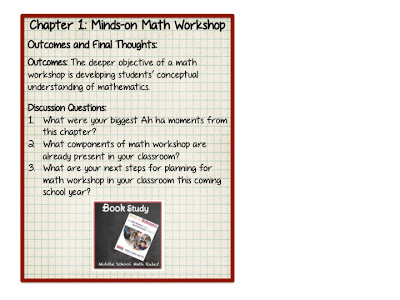
For the first chapter Sherrie gave some discussion questions so I will start here.

From Sherrie's blog http://7thgrademathteacherextraordinaire.blogspot.com/
The biggest Ah ha moments from the first chapter for me:
The chapter highlights the theory behind the minds on math workshop and it was a little like preaching to the choir.  I completely agree that kids are not learning by being talked at.  Although I try so hard not to do it, I am 100% guilty of "putting on the show" or doing the math "tricks" on the board. Although I have gotten much better at it, I am also guilty of jumping in to save them when they are stuck.  I have always subconsciously  thought to myself that if I just "show them how easy it is" they wouldn't be so frustrated.   I am learning that the "struggle" is good!  That is when the learning happens.  If they are not struggling, they already knew it and they are not learning anything! One of things I keep searching for is a way to get kids to take ownership of their learning and I think this is the purpose of the workshop.
Another thing that jumps out at me is that this is going to take WORK on my part!  It sounds like such an easy process to implement and extremely worth it, but whew!  I feel like my kids come to me trained not to have to think but to sit, listen and then finish the worksheet.  Plus retraining myself to let go and let them work!

What components are already present in my classroom:
Well, I would say that I have done workshop type stuff already.  The thing is I have not taken the time to make it work.  I have put them in groups, given them jobs, given open ended problems for them to work on, etc.  I do know that while it didn't always work out the way I wanted, most of the times these types of lessons were the ones I thought were really good.  

What are the next steps for planning workshops in my classroom:
I have to say that I am so happy that I found this book over the summer!  I think the first step is going to be to read through the whole book :)  I know that I will have to rework all of my classroom routines and procedures but like I said I have a feeling that this is going to be well worth it!  


I am excited to read the rest of this book.  Along with a new curriculum next year I have my work cut out for me.  Fortunately, this is the kind of stuff I thrive on. I love change and challenges!