Saturday, August 3, 2013

Books, Books and More Books!

So we are on a little family vaca in Baltimore this weekend.  My daughter turned 16 and didn't want a party, she wanted to visit Edgar Allen Poe's grave site.

 In addition she found a "free" bookstore that she wanted to visit.  It turned out to be the coolest place!  We dropped off a ton of old books that were collecting dust on our shelves and headed in to the "store".


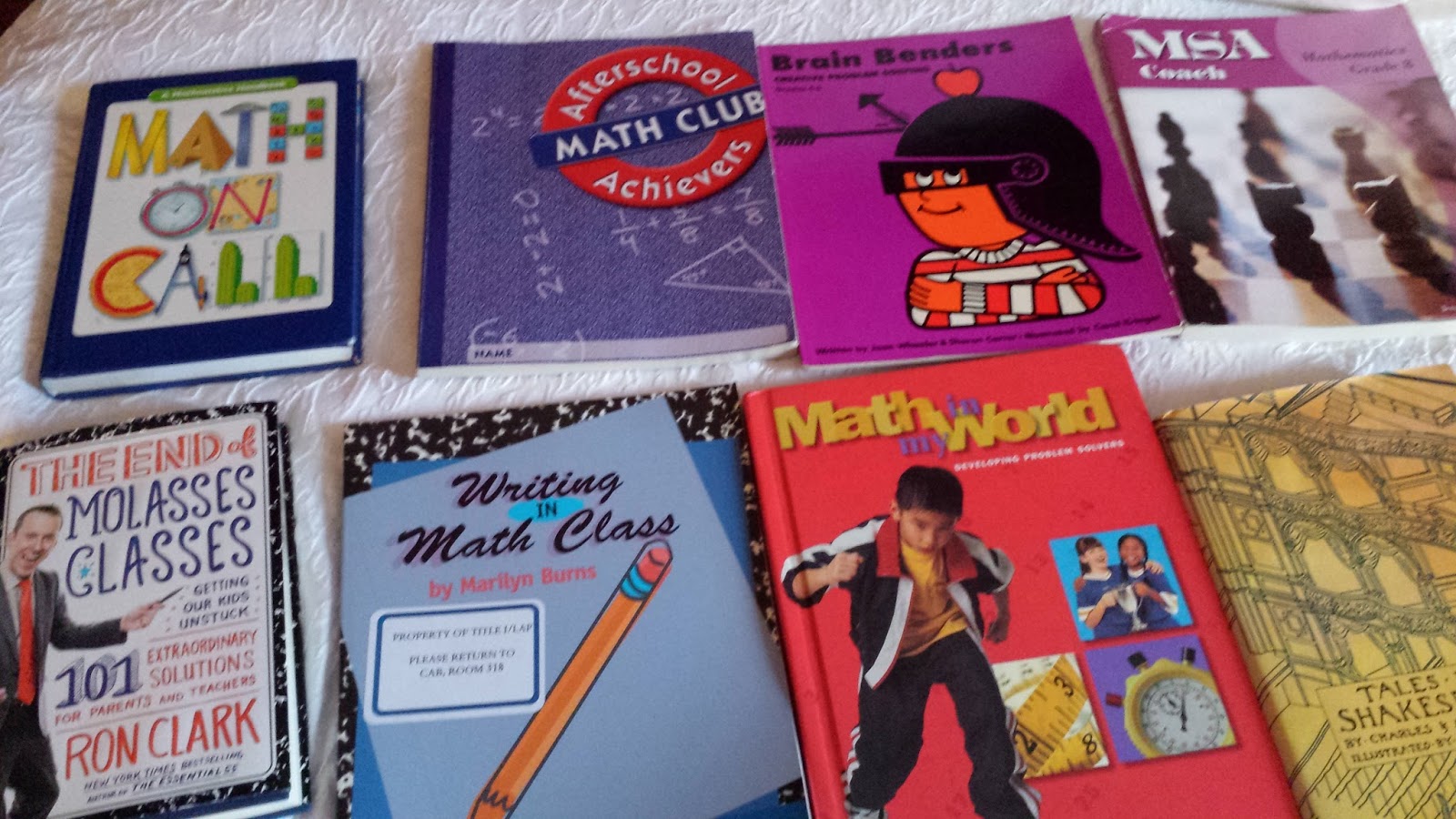
She ended up with about 5 and I found this:

I actually got 4 of those Math on Call books, so that each of my groups can have one for reference :)  Later on we went to the Hardrock cafe and while we waited for our table went over to Barnes and Noble, they were selling the same book for $32 each!!!

I highly recommend The Book Thing if you are in Baltimore, I will definitely like to come back at least once a year or so!

Thursday, August 1, 2013

Mistakes Are Okay, Really!

In the How to Learn Math course, one of the big objectives so far is learning how important it is to let kids know that mistakes are good, they are how we learn and make our brain grow.   One of the things I know is that my students are going to have to be shown this.  I can't just tell them and hope that they magically change the way they have thought about math class for most of their life.  So I've been trying to think of how I'm going to do that and of course it will be my daily actions over time that will make this sink in, however, I wanted some way to really put it out there the first week and I think I might have found it!

Somehow the game Guess Who? popped into my head. Its perfect, because you can use all of your WRONG guesses to eliminate characters in order to guess your opponents character.  I don't have the cash to buy 9 sets of the game but I found character sheets that you can print out here.  The way I am going to have them play is each student will have a plastic communicator with a character sheet in it.  They will draw a card, made with the smaller images taped onto an index card (don't know if I have the patience to glue/tape all 9 sets-might just do a few and pass the cards around!) in order to get their character. If you never heard of the game, you ask your opponent questions in order to figure out the character they have, like "is your character a girl?" if they say no, you cross out all of the girls (if yes, you cross out all of the boys.)  You keep going until you've eliminated enough to guess their character.   Here is a rough set I made up already:
the game board

The cards to select the characters
My plan is to start using the workshop model right away.  Usually my first week is dedicated to setting up routines and procedures, so this will fit right in.  Here is what I have so far:
Opening:  Students will do a maze.  This will set up the discussion about using mistakes to find the right path.
  Minilesson: This is when I will explain the game and the rules for playing. I'm not sure if I will talk more about mistakes here, but I know that I want to keep this short: no more than 10 minutes.
Work Time: I plan on giving them about 20-25 minutes to play the game.
Conferring:  This is when I will try to meet with as many as I can and get them to start feeling comfortable with this process.  Maybe ask things about the strategies they are using, if they would take a chance on guessing without asking for clues, etc.
Sharing/Reflection: The most important thing I want them to think about is this- Can you win the game if every question you asked was answered with "No."? Hopefully they will see that yes, the "wrong" questions can lead you to the right answer!  I still have to work on the questions, I know I have to give them a LOT of structure, especially in the beginning of the year!  After discussing, I am also going to have them write about the activity in their notebooks.


I know I need to think more about structuring the sharing/reflection time, this is where my kids are going to need a lot of practice.
I'm still not sure of my schedule yet, we have 50 and 75 minute classes, and ABCD days, so each class gets a different amount of time each day.  I'm still not sure how to plan for this.  Last year was a mess, with one of my 7th grade classes getting almost a whole hour more of class than the other one.  Admin was trying to fix this, but I don't know yet what they did.  I've been thinking of making my daily plans for the 50 minutes and then doing something different for the 25 minutes that a class might get that day.  Any suggestions for this????

Tuesday, July 30, 2013

Minds on Math: Chapter 10 "Sharing and Reflection"

Problem of the Day:  How can we ensure that students end class understanding and retaining their learning?

At the end of the math workshop we need to let students share out either as a whole group or in small groups/pairs. The idea is that talking out their thoughts about the work they just did with their peers will help them retain it better.  After sharing, students should reflect on their own learning by writing about it.

I have always tried to schedule time in my lessons for sharing.  However, we would often run out of time.  Something I notice about the workshop model is that the components seem very familiar to the things I feel I do now (Opening=Do now, minilessons, sharing, etc) but with a different importance placed on them.  I used to let us run out of time if the students were working hard on their classwork, I figured that was when they were learning.  But if by making sure they had that time to share and talk it out they would retain it more, then it will be worth it.  I also like the idea of sharing in pairs or smaller groups.  I like the idea of having the kids get up and pair off with a student from another group at the end.

Now for reflection, I'm thinking, "well, if I run out of time for sharing, how in the world am I going to have time for reflection?!"  One of my thoughts is, why not make it part of the opening routine.  This way students can reflect on what they learned the day before in preparation for the day's lesson.

I am now ready to reread this whole book and really get down to planning out my workshops!

Sunday, July 28, 2013

Ability Grouping?

I work in a small charter school, there are 36-8th graders that are split into 3 homerooms of 12 students.  The 7/8 science teacher and I usually decide the 8th grade classes since we teach them as 7th graders.  Usually we split them up based on personality and behavior.  This year we are toying with the idea of ability grouping to an extent.  Of our 36 kids, there is a bottom 12, these students consist of sped and ELL's along with a few who it just takes a little longer to "get it".  We want to put these students together in a HR (HRs travel to every class together) and evenly distribute the rest between the other two homerooms, meaning no "high level" class.  I have such conflicting thoughts on this based on the research showing how bad this is.  However, I truly feel that we (8th grade teachers) would hold these students to the same expectations as the other two classes, its just the way we would deliver lessons and structure the classes that would be different.  I feel that we would be giving this class the chance to think for themselves and show them how excellent they really can be!

I guess I am looking for feedback from others that have done this.  Does it work, am I right to be hesitant?

Saturday, July 27, 2013

Minds On Math: Chapter 9 "Conferring"

Problem of the Day:  How can you get to know your students individually as math learners, promote their confidence and growth?

This chapter discusses what teachers can do while students are busy during work time-meet with students.  Two things really stick out about this chapter, one is the need to really organize and plan how you will confer with students and the second is teaching students how to confer with you and how to act when you are conferring with others!

Starting off with the plan of attack, according to the author, we should be doing three things:  finding out exactly where the student is in the learning process, guiding the student towards the learning goal and making notes about the progress/meeting (p 145-146)  I absolutely love the list of questions for each stage provided on page 147.  This would be a good thing to laminate and attach to my clipboard as I go around to students.

Next, this process is a routine that will need to be introduced and explained so that students don't feel like they are being put "under the spotlight" and so that other students learn to respect others' time.  Students need to learn what the purpose of the meeting is and how it will help them.  They need to buy into the fact that it will benefit them.  They also need to learn that individual meetings must be respected. This will definitely be one of the procedures I will start the year off teaching.

Hoffer points out that it will take time to learn how to confer with students and at first you might only get to meet with 1 or 2 students per class.  I am wondering if I can confer with groups at a time.  I still haven't decided how I am going to group my students for work time yet, but I am thinking if I have a preset group, I can make record sheets for each group which might make it easier to meet with more students and record/reflect.

I really think meeting with students to discuss their learning is important.  Students need to receive meaningful feedback and feedback other than grades.  In the "How to Learn Math" course I am taking there is a big emphasis on learning from mistakes but most of my students have to learn that mistakes are good, this would be a great time to teach this to them.


Tuesday, July 23, 2013

Mind on Math: Chapter 8 "Work Time"

Question of the Day: How can we facilitate thoughtful and productive work time for math learners?

And here we have what I think has got to be the most difficult and most important part of math workshop! Work time is where we schedule these challenging tasks and differentiate learning.

Grouping has always been an issue for me since I teach small classes.  We seem to have anywhere from 5-6 very low students and then 10-11 on level with only about 1-2 truly above level.  My lows sometimes get pulled out as an intervention with the RTI specialist, so I've tended to put them together in the past.  When I mix them up with the others, they totally let the others do the work, even when I give them a task.
This year we are thinking about taking those very low 8th graders and putting them together in one homeroom (there are 3- 8th grade homerooms with 12 students and they stay together for all of their classes) and this is something I keep going back and forth with.  I have read all of the bad things about ability tracking, but I really think that we will do a good job of NOT lowering expectations for these students, but actually push them to achieve more.   So anyway where I am going with this is that if we do go ahead with it, I will have no problem doing random groups all the time, or groups based on their preassessments.   Now the 7th grade is a different story, there are only 2 homerooms with 18 in each.  Not sure how that is going to work.

I think getting the students to actually WORK during this time is going to take a lot of practice and going over the expectations.  I am going to begin the year by describing my Norms of the class and having the students create strategies and rules and I am hoping that this will help.  I keep having these delusions that if I just come up with tasks that are challenging and engaging enough, they will just get to it!  But I'm sure it is going to take a lot more work on my part!

Which leads into what the teacher is doing during this time:  I cannot wait to get into the conferring section.  I know from the How to Learn Math course, that giving good feedback is really essential for learning and students thinking about their ability to learn.  There is also gathering data which we are required to do in my school anyway.  We use a circle chart.  It is a spreadsheet with the students names listed in the left column and the concepts we are teaching along the top row.  We leave the box empty if students don't have any understanding, one line of a plus sign if they are beginning to get it and then a full plus if they got it.

I am getting really excited about planning everything for this school year using the workshop model!

Sunday, July 21, 2013

Minds on Math: Chapter 7 "Minilessons"

Problem of the Day: How do you set students up for success as independent thinkers and problem solvers?

This chapter has a lot to offer.  The minilessons are our chance to teach students to think like mathematicians. The purpose or goal is not to teach algorithms or procedures but to model the thinking by doing things such as highlighting the use of background knowledge and teaching problem solving skills.

This is an idea that I will have to get used to since I am a relatively new teacher and have been coached in my approximately 3 years teaching to demonstrate the steps.  My school is big on the "I do","We do", "You do" method.  However I feel like that this method requires students to see every type of problem done in order to learn it.  They are learning to follow steps instead of learning how to think mathematically.  I am hoping that focusing on teaching the mathematical thinking will help them to learn how to apply the concepts, rather than just imitate the steps.

Oh and I have to share some GREAT videos from a school that uses the math workshop.  It really is cool to see it in action!  Check them out here: 6th Grade and 7th Grade